
All ship launching airbags must meet the following test criteria.
How is the test condition?
Unless otherwise specified, tests shall be performed under the following conditions:
a) ambient temperature: 10 degree ~35 degree
b) media: (1) dry clean compressed air, and (2) clean fresh water for bursting test.
Testing instruments, including pressure gauages and testing machine, shall be calibrated.
The test shall be performed using a full-sized air bag. If the air bag is too large to be mounted on the test machine, the test may be performed on a scaled-down air bag. In order to maintain a proper representation of the full-sized sample airbag, the diameter of the scaled-down air bag shall be no less than 1/2 of the full-sized sample air bag diameter while the length (L) shall be no less than 3 times the diameter of the scaled-down air bag.
Compression Test
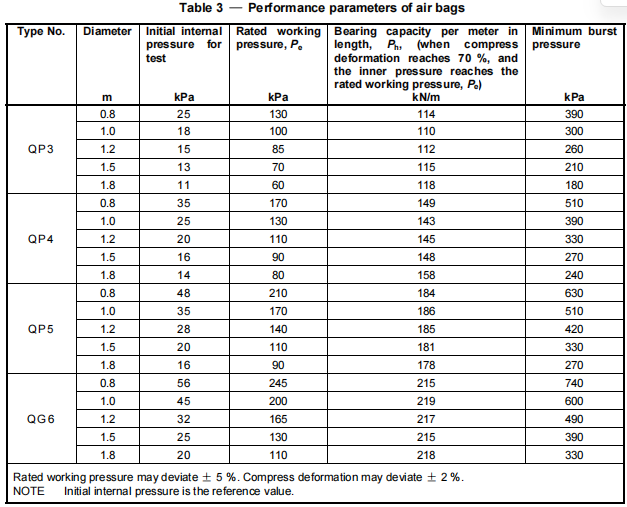
Compression test under the initial internal pressure specified in Table 3 should be carried out after the tests of 5.1, 5.2, 5.3 and 6.3
The air bag is to be put on a press with large enough width and length to ensure that all parts of the compressed air bag is within the press. The test should be conducted as follows:
a) fill the air bag to the initial pressure in Table 3, start the test machine and press the air bag perpendicularly till the percentage deformation reaches 70%. Observe to see if the air bag is functioning properly;
b) gradually reduce the compressive force on the air bag until the air bag, by its own flexibility, returns to the height of its original state. Record the internal pressure;
c) apply a compressive force perpendicularly to the air bag again, till the percentage deformation reaches 70%
During the course of compressing and releasing, the reaction forces, internal pressures and deformation rate should be recorded at every 10% deformation interval.
The compression performance curve of a QG6 air bag is shown in Figure A.1. The rated working pressure of the air bag is as specified in Table 3.