
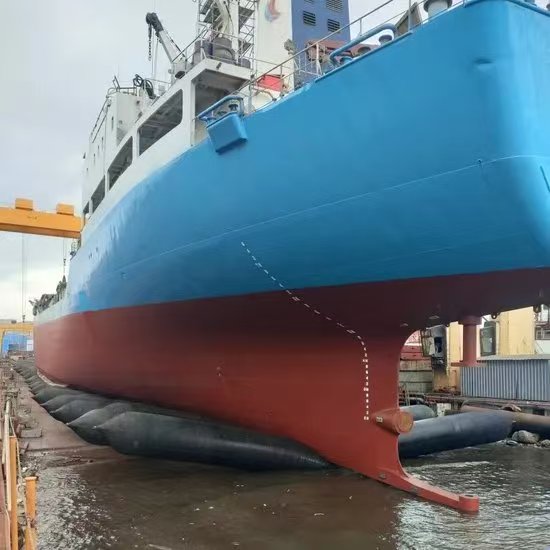
Launching a newly built or repaired vessel is one of the most critical moments in any shipyard. Traditionally, yards relied on fixed concrete slipways, greased wooden ways, or expensive dry docks. Today, more shipyards around the world use marine airbags—heavy-duty inflatable rubber rollers—to launch ships safely, flexibly, and at a fraction of the infrastructure cost.
This guide explains how to launch the ships with marine airbags in shipyards, covering the working principle, pre-launch calculations, step-by-step procedure, safety rules, and ISO standards you must know before the first bag is inflated.
What Are Marine Airbags and How Do They Work?
Marine airbags (also called ship launching airbags or rubber roller bags) are cylindrical, cord-reinforced rubber tubes inflated with compressed air. Placed under the hull, they:
- Lift the vessel off its keel blocks
- Act as low-friction rollers
- Carry the hull’s weight down a prepared slipway
- Let buoyancy take over when the stern enters the water
Most commercial bags follow ISO 14409:2011 (construction and testing) and ISO 17682 (launch method references). Typical diameters run 0.8–2.5 m, effective lengths 6–24 m, working pressure 0.05–0.20 MPa, with a burst safety factor of ≥ 4:1 versus working pressure.
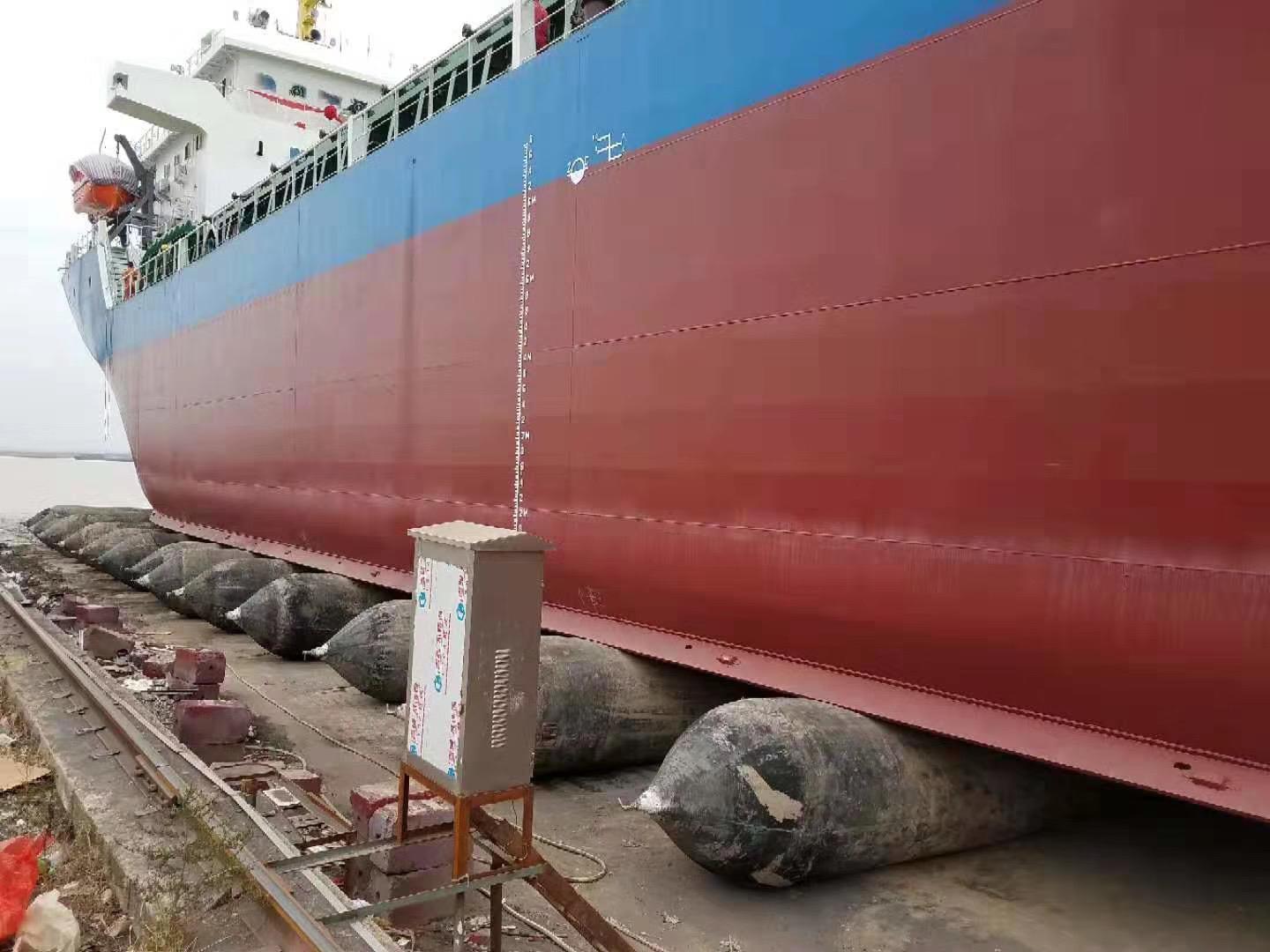
Why Shipyards Choose Airbag Launching
- Lower capital cost – no permanent rails, cradles, or deep slipway
- Reusable – a quality airbag fleet lasts 8–15 years and hundreds of cycles
- Flexible site – works on concrete ramps, compacted soil, or temporary beaches at slopes as low as 1:70
- Even hull load – rubber conforms to hull shape, reducing stress on plates and frames
- Portable – deflated bags pack into containers and move to remote repair sites
Pre-Launch Engineering Checklist (Do Not Skip)
A safe launch is 80% calculation and 20% inflation.
Before moving anything, the shipyard must confirm:
- Vessel lightship weight, DWT, LOA, beam, and center of gravity
- Hull structural strength at keel and frame lines
- Slipway gradient (common 1:10 to 1:20; airbags can handle milder)
- Ground/surface condition: clean, level, no sharp debris
- Required water depth at entry point (usually ≥ 1.5× stern draft)
- Tide table and current/wind limits (avoid > Beaufort 4–5 if possible)
- Winch capacity, ground anchors, wire ropes, and emergency brake system
- Airbag specs: diameter, effective length, ply count, rated line load, certified pressure
Rule of thumb: total airbag line-load capacity must exceed hull weight per unit length with a safety margin (many yards add 30% spare capacity and keep 2–4 spare bags on site).
Step-by-Step: How to Launch the Ships with Marine Airbags in Shipyards
Step 1 – Prepare the Slipway and Launch Track
Clear all nails, rocks, weld beads, and sharp edges. Fill pits with bagged sand, grind protrusions. Lay steel plates or chafing strips if the surface is rough concrete or gravel. Mark airbag centerlines with chalk.
Step 2 – Position Deflated Airbags Under the Hull
Place bags transverse to the launch direction for end-on launches (or per engineered layout for side launches). Spacing depends on hull weight distribution—denser under midship, wider under lighter ends. Keep bags perpendicular to the centerline and never twisted.
Step 3 – Connect Air Supply and Inflate Gradually
Use calibrated compressors (typical supply 6–8 m³/min below 0.8 MPa). Inflate slowly to working pressure (e.g. 0.08–0.12 MPa for mid-size bags). As pressure rises, the hull lifts evenly off the blocks. Remove keel blocks only after the hull is fully borne by bags.
⚠️ Never exceed the manufacturer’s rated working pressure. Watch the gauge continuously.
Step 4 – Level the Hull and Fine-Tune Pressure
Adjust individual bag pressures so the hull stays level within a few centimeters. Uneven pressure causes tilt, premature bag wear, or hull stress. Confirm bags do not pinch against frames.
Step 5 – Engage Holding Winch and Begin Controlled Roll
Attach bow/stern holding wires to ground anchors via winches and pulleys. Ease the brake slowly. The vessel rolls forward at 0.5–1 m/s (≈ 6–13 m/min). Guide ropes correct yaw. The airbags rotate under the keel like conveyor rollers—rolling friction is far lower than sliding ways.
Step 6 – Water Entry and Buoyancy Transfer
As the stern touches water, hydrostatic lift progressively sheds load from rear bags. Keep winch tension in narrow channels; in open water, the final hold-back wire may be released at the planned moment. Mooring lines on bollards control drift.
Step 7 – Deflate, Recover, and Inspect
Once afloat, reduce bag pressure below 0.03 MPa before disconnecting hoses. Recover bags, rinse with fresh water, check for cuts or deformation, dry, dust with talc, and store flat in shade. Record hull draft, check watertightness, and file a launch report.
Common Mistakes That Cause Failed Launches
- Sizing bags by diameter only, ignoring certified line load and ply count
- Excessive airbag spacing → hull sagging between supports
- Dirty slipway with rebar ends → sudden puncture
- Overinflation “just to be safe” → burst risk
- No winch control → runaway speed and hull yaw
- Ignoring tide/current and shallow entry depth → grounding
Safety Standards and PPE
- Use only bags built to ISO 14409:2011 with airtightness test (≤5% pressure loss/hour) and burst margin ≥ 3× working pressure
- Fit each bag with pressure gauge, relief valve, and steel end flange
- All crew in helmet, life jacket, anti-slip boots; non-essential staff outside launch zone
- Walkie-talkies for pressure watcher, winch operator, and water-entry spotter
- Emergency stop on compressor and winch
FAQ: Ship Launching with Marine Airbags
Can airbags launch large ships?
Yes. Modern yards have launched barges, tugs, ferries, fishing vessels, and cargo ships well over 5,000 t. Very large vessels need stricter calculation, more bags, and class approval—but the principle is identical.
What slope is needed?
Traditional greased ways often need 1:20. Airbags can work on 1:70 to 1:10 depending on weight, friction, and winch control.
How many times can an airbag be reused?
With proper cleaning, pressure testing, and storage, 8–15 years and hundreds of cycles are normal.
Are marine airbags the same as pneumatic fenders?
No. Fenders absorb impact at berths (ISO 17357). Launching airbags lift and roll hulls (ISO 14409). Different shape, reinforcement, and load math.
Final Takeaway
Knowing how to launch the ships with marine airbags in shipyards is not about inflating rubber and hoping for the best. It is a controlled engineering operation: calculate load, pick ISO-certified bags, prep a clean track, inflate to rated pressure, roll under winch control, and recover safely. Done correctly, airbag launching cuts cost, protects the hull, and works on sites where a classic slipway would never pay back.
If your yard is planning its first airbag launch, engage the bag manufacturer’s engineer early—share hull lines, weight table, and slipway profile before you buy a single bag.